
| Quick Answer Size the keg to your guest count and event length, pre-chill it 24 to 48 hours ahead, and tap it the same day as the reception, ideally an hour or two before cocktail hour. Dress the keg tub with a table skirt or linen wrap so it blends into the reception decor, confirm the setup with your venue or caterer ahead of time, and use a battery-powered tap like the Kegr to skip the CO2 tank and hand-pumping entirely. |
Draft beer has become a popular alternative to a full open bar at wedding receptions. It costs less per serving than bottles or cans, it feels more like a real party than a stocked hotel bar, and with the right setup it does not have to look like a backyard cookout sitting next to your reception tables. The tricky part is that a wedding has more moving pieces than a normal party: a venue with its own rules, a timeline that cannot slip, and guests who expect the whole thing to look intentional. Here is how to plan around all of that.
How Much Beer You Actually Need
Start with your guest count and estimate what share will actually drink beer rather than wine, cocktails, or nothing at all. A common planning rule is two to three 12-ounce beers per drinking guest for a four-hour reception, more if the bar opens during cocktail hour too.
| Keg Size | 12 oz Servings | Good Fit For |
| Sixth-barrel (sixtel) | ~55 | Under 25 guests, or a second style alongside a bigger keg |
| Quarter-barrel (pony keg) | ~82 | Under 50 guests, or paired with a second style |
| Half-barrel (full keg) | ~165 | 100+ guests, beer-focused reception |
A Worked Example
Say you are expecting 120 guests, and based on your RSVPs and knowledge of the crowd, you estimate 70 percent will drink beer at some point during a five-hour reception that includes cocktail hour. That is 84 beer drinkers. At roughly two beers per person over the full event, you land at 168 servings, which is almost exactly one half-barrel. Most planners round up slightly rather than exactly matching the math, since running out during a wedding reception is a much worse outcome than having a partial keg left over. A single half-barrel with a backup case of canned beer on ice is a reasonable plan for this guest count.
For a full breakdown by guest count and event length, including quarter-barrel and multi-keg scenarios, see our guide on how many kegs you need for a party.
Coordinating With Your Venue and Caterer
This is the step most first-time hosts skip, and it is the one most likely to cause a problem on the day of. Many wedding venues have specific rules about outside alcohol, insurance requirements, or whether a licensed bartender has to be the one pouring. Some venues are happy to let you bring your own keg as long as it is served by their staff or a hired bartender. Others do not allow outside alcohol at all if they have their own liquor license and bar program.
- Ask your venue directly whether outside kegs are allowed, and whether they require a licensed server to pour
- Check whether your venue or wedding insurance requires host liquor liability coverage for self-served alcohol
- Confirm where the keg tub is allowed to sit, some venues restrict certain areas for fire code or flooring reasons
- Ask your caterer if they can supply ice, since ordering through them is sometimes easier than sourcing 40 to 60 pounds yourself the morning of
- If a day-of coordinator is managing your timeline, loop them in on when the keg needs to be tapped so it lines up with cocktail hour
None of this needs to happen more than a few weeks before the wedding, but it should happen before you finalize your keg order, since a venue rule can change your plan entirely.
Timing the Tap
Because tapping introduces air into the keg, the beer starts losing freshness the moment the tap goes in. That is true with a hand pump, CO2, or an electronic air-pump tap. Tap the keg the same day it will be served, not the night before.
| Timing tip. Tap the keg one to two hours before cocktail hour begins. That gives it time to settle after any transport agitation and reach serving temperature (36 to 40 degrees Fahrenheit) without sitting tapped and losing freshness before the first pour. |
If the keg was transported any real distance, whether by you, a family member, or a delivery service, build in extra rest time. A keg that was jostled around in a car for thirty minutes needs closer to an hour of undisturbed settling before it will pour cleanly, rather than the ten or fifteen minutes people often assume is enough.
Making the Setup Look Elegant
- Skirt the keg tub with linen or a woven basket wrap to hide the ice and metal
- Set the tub on a proper drink table rather than the ground, ideally matching the height and finish of your other bar furniture
- Use a battery-powered tap with no hose reel or CO2 tank to keep the station visually clean
- Keep a drip tray or towel under the tap to avoid puddling on rented flooring or a tent floor
- Add simple signage, a printed card naming the beer being served, so the station feels styled rather than improvised
A surprising amount of what makes a keg station look like a wedding bar instead of a tailgate comes down to what is visible above the table line. Guests never see the ice or the tub itself if it is skirted properly, they just see a clean tap and a cup being filled, which reads the same as any other bar setup at the reception.
Staffing and Service
Decide early whether the keg will be self-serve or staffed. A staffed station keeps pours consistent and prevents overfoaming from guests who are not used to pouring draft beer, and it is often required anyway if your venue mandates a licensed server for any alcohol service. If you are going self-serve, which some smaller or more casual receptions do allow, a simple sign with pouring instructions helps a lot, since most guests have never poured from a keg tap and will overfill or underfill without guidance.
A tap with an app that shows remaining keg level, like the Kegr, is genuinely useful here even if you are not staffing the station yourself. A coordinator, parent, or member of the wedding party can glance at their phone periodically to see how much beer is left, rather than needing to physically check the tub, which keeps the whole thing running smoothly without anyone being visibly assigned to babysit it.
Indoor, Outdoor, and Weather Contingency
Where your reception is happening changes a few practical details. An indoor reception with climate control needs less ice replenishment than an outdoor or tented one, since the keg tub is not fighting ambient heat all afternoon. If your reception is outdoors or in a tent without full climate control, treat the keg setup the same way you would a summer backyard party, with more ice on hand and a shaded spot for the tub.
Weather contingency plans matter more for a wedding than almost any other event, simply because the date cannot move. If your reception has an outdoor component with an indoor backup, decide ahead of time where the keg station goes in each scenario, and make sure both locations work logistically, flat ground, access for setup, and a spot that will not block foot traffic.
It is also worth thinking through what happens if the weather forecast changes the week of the wedding rather than the day of. A keg order placed for an outdoor reception generally does not need to change if the event moves indoors due to rain, but the tub location, ice plan, and who is responsible for moving the setup on short notice are all worth deciding in advance rather than figuring out in the moment. Most day-of coordinators are used to managing this kind of pivot, so if you have one, loop them in on the keg specifically rather than assuming it will get handled as part of the general weather plan.
Budget: Keg Versus a Full Open Bar
One of the main reasons couples choose a keg over a full bar package is cost. A staffed open bar with a full liquor selection typically runs on a per-person or per-hour basis and adds up quickly across a hundred-plus guest list. A keg, by contrast, is a fixed cost for the volume of beer you order, plus a modest deposit that comes back when the empty keg is returned.
| Option | Cost Structure | Best For |
| Full open bar | Per-person or per-hour, scales with guest count and hours | Couples wanting a full liquor and wine selection |
| Beer and wine only bar | Lower than full bar, still per-person in most cases | Middle ground between cost and variety |
| Keg plus limited wine or signature cocktail | Fixed cost for the keg, plus wine by the bottle | Cost-conscious receptions that still want variety |
Many couples land on a hybrid: a keg or two for beer, paired with a modest wine selection and maybe one signature cocktail, rather than a full bar. This keeps costs predictable and still gives guests real choice. Exact pricing varies enormously by region, caterer, and beer brand, so treat this as a framework for the conversation with your venue or caterer rather than a fixed number.
Common Mistakes to Avoid
Most keg problems at weddings trace back to one of a handful of avoidable mistakes, usually made by first-time hosts who are also juggling a dozen other wedding logistics at the same time.
- Ordering the keg too late and finding out the specific beer is on back order or needs a week of lead time
- Assuming the venue allows outside alcohol without actually confirming it in writing
- Tapping the keg too early in the day, leaving it losing freshness for hours before guests even arrive
- Not assigning anyone specific to monitor ice and keg level, leaving it to whoever happens to notice
- Underestimating how heavy a half-barrel is and not arranging a hand truck or second person ahead of time
- Forgetting to confirm the return window and deposit policy, which can mean a late fee tacked onto an otherwise smooth event
Most of these are avoidable with a single conversation a week or two out, either with your venue, your caterer, or whoever is helping coordinate the day. The cost of checking is a five-minute phone call. The cost of not checking is finding out mid-reception.
A Sample Wedding Day Timeline
| When | What Happens |
| 1 to 2 weeks before | Order keg and confirm venue rules on outside alcohol |
| 1 to 2 days before | Pick up keg, begin refrigerating or arrange cold storage |
| Morning of the wedding | Confirm ice supply, charge the Kegr, confirm tub location with venue staff |
| 1 to 2 hours before cocktail hour | Set up tub, ice down keg, let it rest after any transport |
| 30 minutes before cocktail hour | Attach tap, pour a test cup, confirm temperature and pressure |
| Throughout reception | Check ice and keg level every 2 to 3 hours depending on weather |
| End of reception | Detach tap, offer leftovers to guests or family, return keg for deposit |
Frequently Asked Questions
What is the most common mistake couples make when planning a keg for their wedding?
Underestimating setup time. Between pre-chilling, venue coordination, and letting the keg rest after transport, a keg needs more lead time than people expect. The second most common mistake is skipping the venue conversation entirely and finding out the week of the wedding that outside alcohol or self-service is not allowed.
Can you tap a keg the night before a wedding?
It is not recommended. Once a keg is tapped, oxygen enters the space where beer used to be, which gradually flattens carbonation and dulls flavor. Tapping the same day, ideally just a couple of hours ahead, keeps it tasting the way it should for the whole reception.
How many kegs do I need for 100 guests?
For a typical four-hour reception where most guests drink beer, plan for roughly one half-barrel per 100 to 130 guests, or two quarter-barrels for variety between two styles. See our full guide on how many kegs you need for a party for a size-by-size breakdown and worked examples.
Do you need a CO2 tank to tap a keg at a wedding venue?
Not with every tap. Traditional systems use a CO2 tank to push beer through the line, but electronic air-pump taps like the Kegr run on a rechargeable battery instead, so there is no tank, no hose, and nothing to coordinate delivery or pickup around the wedding.
Does my venue need to know I am bringing a keg?
Almost always, yes. Many venues have rules about outside alcohol, insurance requirements, or a requirement that a licensed server pours any alcohol on site. Confirm this before you finalize your keg order so you are not caught off guard the week of the wedding.
Can a keg be self-served at a wedding?
It depends on your venue and local regulations. Some venues and jurisdictions allow self-serve alcohol at private events, others require a licensed bartender to pour anything served. Check with your venue directly rather than assuming either way.
How do you keep the keg cold without it looking out of place?
A skirted or linen-wrapped keg tub packed with an ice and water mix works well and stays out of sight under the fabric. For more on ice ratios and setup, see our guide on how to keep a keg cold at a party.
What happens to leftover beer after the reception?
Once tapped with any air-pump tap, beer should be finished the same day for the best quality. If there is beer left at the end of the night, offering it to family helping with cleanup or vendors packing up is a common, low-waste option before returning the keg.
Is a quarter-barrel enough for a smaller wedding?
For an intimate wedding under 50 guests, a quarter-barrel, holding about 82 servings, is often plenty on its own, especially if wine or a signature cocktail is also being served. See our comparison of quarter-barrel versus half-barrel for help deciding.
Should the keg be set up before or after the ceremony?
Set it up and ice it down before the ceremony if your timeline allows, but hold off on tapping it until closer to cocktail hour. This way the keg is cold and ready the moment guests arrive at the reception, without sitting tapped and losing freshness during the ceremony itself.
Who should be in charge of the keg on the wedding day?
Ideally someone who is not in the wedding party and does not have other responsibilities that day, a family friend, a hired bartender, or a staff member if your venue provides one. Whoever it is should know the tapping timeline, where the ice is stored, and how to check the Kegr app if you are using one, so it is not something the couple or immediate family has to think about.
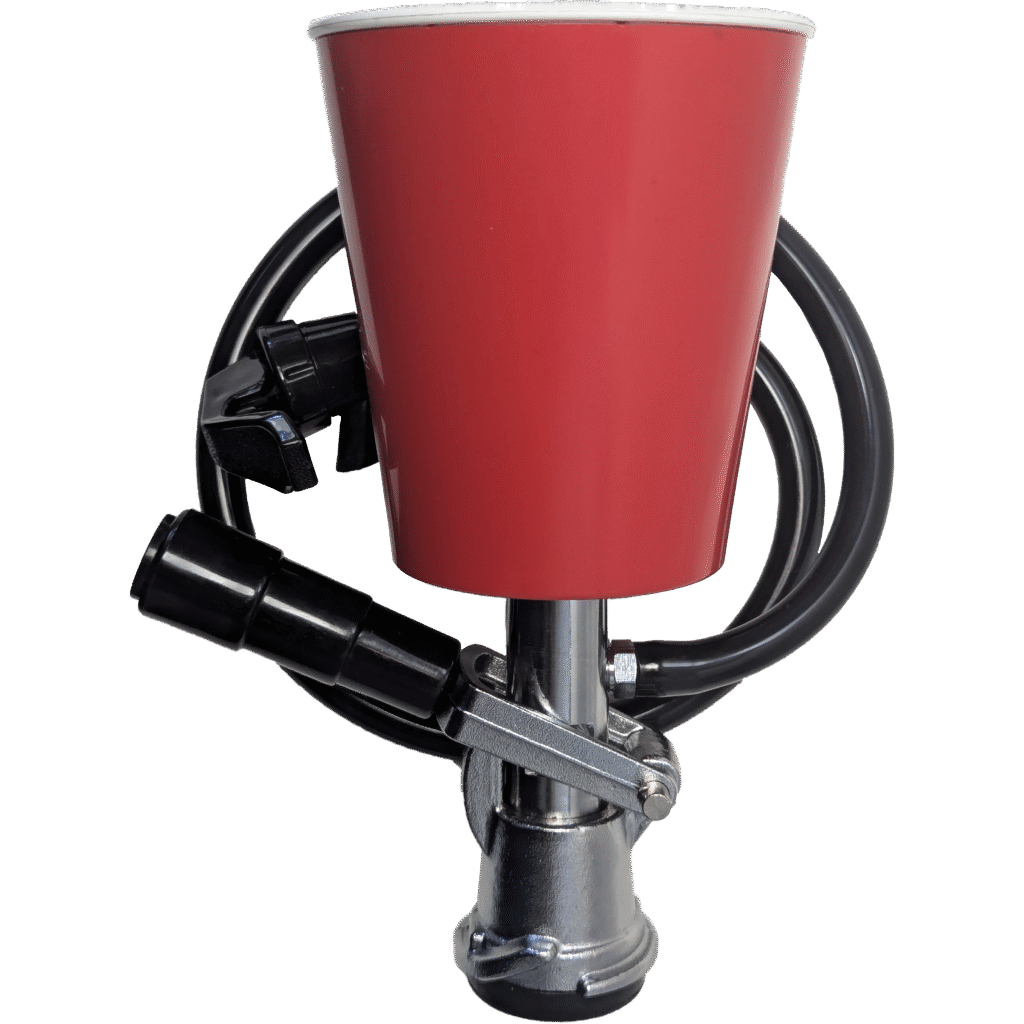
The Kegr — Electronic Keg Tap
Automatic pressure. No hand pumping. No CO2. Bluetooth app monitoring. Free shipping on all US orders.
$239.99$199.99 — Get the Kegr →